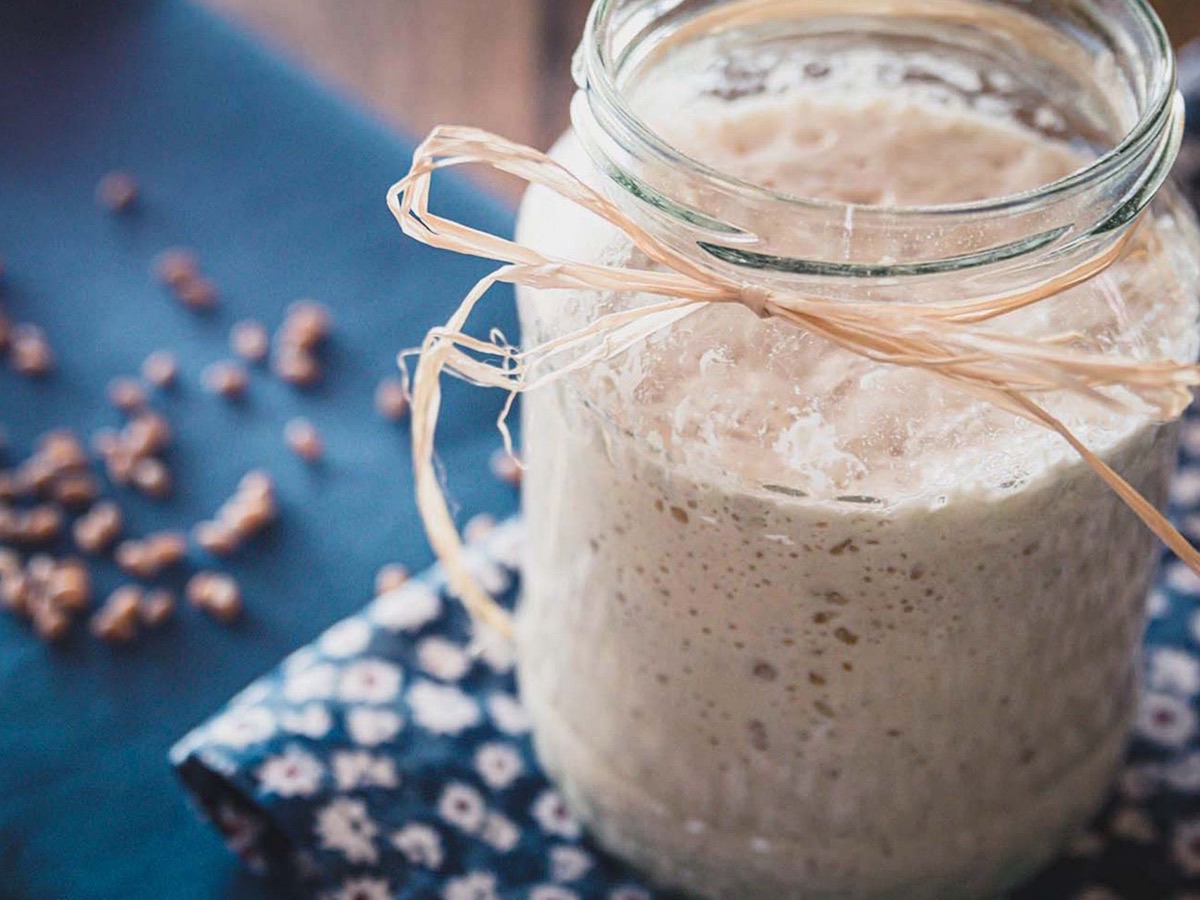
A jar, some flour and ten days of patience. How a starter actually works, what the false lull means, and why neglect is easier to survive than fuss.
The first starter I owned arrived in a jam jar from a friend who had kept it going for six years. I treated it badly. I left it on a warm radiator, forgot it for a fortnight, and then wondered why the bread tasted thin and sharp. It took two more attempts before I understood that a starter is not a delicate heirloom. It is a small, sturdy colony of yeasts and bacteria that wants the same things you do: food, water and somewhere neither freezing nor tropical.
What is actually in the jar
Flour and water, nothing else. Wild yeasts from the flour and the air, plus lactic and acetic bacteria, get to work on the starches. The bubbles are carbon dioxide. The sourness comes from acids the bacteria produce. You are not cultivating a personality; you are managing a population, and the population responds to temperature and feeding in very ordinary ways.
This matters because most starter advice is written as if the jar were a moody houseguest. It is closer to a garden bed. Keep it fed, keep it at a sensible temperature, and it will do what you need. Miss a feed and it will sulk for a day, not die. Leave it in the fridge for a month and it will come back after two or three regular feeds.
Begin small and keep it plain
Thirty grams of wholemeal flour and thirty grams of warm water in a clean jar is a good start. Use a jar no bigger than a jam jar, so the mixture fills a third of it and the bubbles have somewhere to climb. Stir, scrape down the sides, and set the lid on loosely so gas can escape. Keep it somewhere around 20 to 24 degrees Celsius, out of direct sun.
Feed it the same amounts once a day, discarding all but a spoonful of the old mixture first. The discard goes into a separate jar in the fridge for pancakes and crackers. Wholemeal helps at the beginning because it carries more of the organisms you want. After a week you can move to white flour, which makes a milder starter and a more predictable rise.
The signs to read
On day two or three the jar may bubble enthusiastically and then go quiet. That lull is normal. The first burst is often not the colony you want, and the true starter takes eight to twelve days to establish. Watch for a dome of small bubbles, a smell like yoghurt and green apples, and a rise within four to six hours of feeding. If it smells of nail polish, it is hungry. If a dark liquid collects on top, pour it off and feed more regularly.
Use the starter when it is at its peak, just before it falls back. A jar that has doubled and is still domed is ready; one that has collapsed is already hungry again. A tablespoon of the peak mixture leavens a loaf. The rest is fed and put away.
Keeping it without ceremony
Once the starter doubles reliably, it can live in the fridge. Feed it weekly, let it sit out for an hour before it goes back, and take what you need for a bake a day ahead. If you bake weekly, this is enough. If you bake less, dry a few tablespoons on baking paper, crumble it into a labelled jar, and keep that as insurance.
There is no need for scales calibrated to the gram of a god, nor for bottled water unless your tap is heavily chlorinated. If it is, draw a jug the night before and let the chlorine dissipate. A starter survives neglect far better than fuss. Mine has now outlived the friend's original jar, and the bread is better than anything I made in that first chaotic month.